
How to Position and Aim Your External Antenna Correctly
To ensure your booster provides optimal signal amplification, the external antenna must be positioned correctly. Here’s a step-by-step guide to help you aim the antenna toward the nearest mobile base station.
Start with a Signal Check
Before you begin the antenna positioning, check the signal strength in your location:
- Signal Bars: Use the signal bars on your phone as a basic indicator.
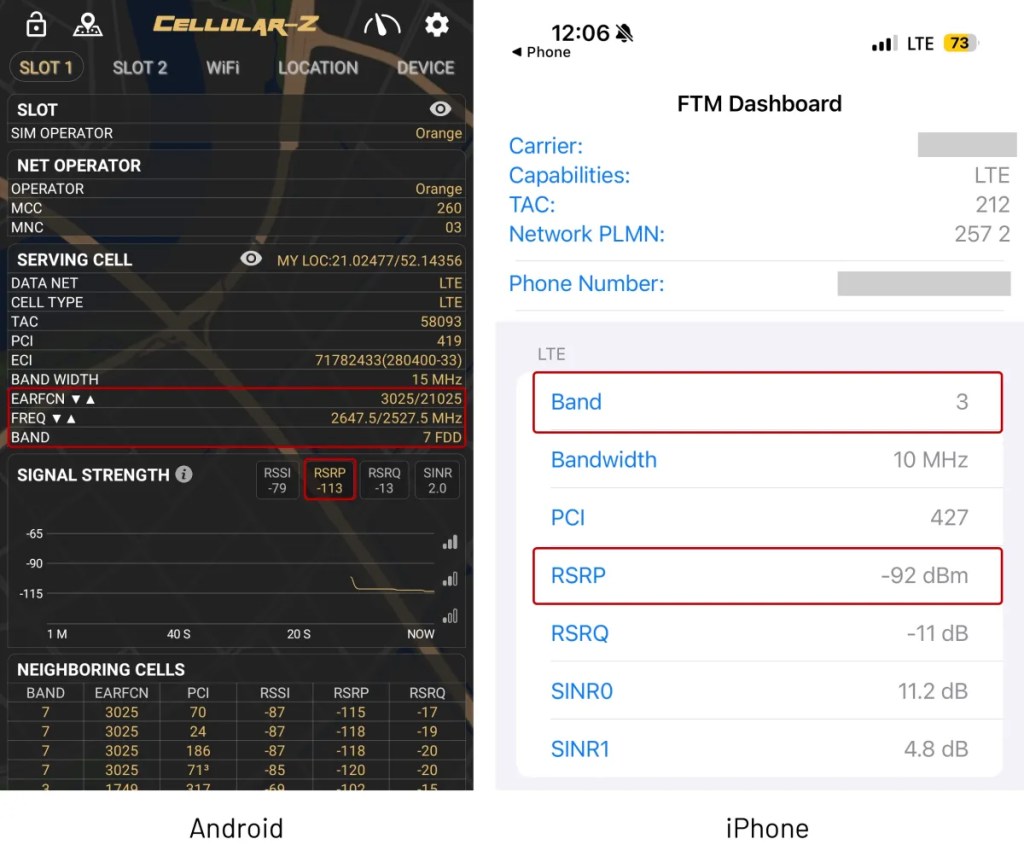
- Precise Measurement: Since the scale of signal bars can vary between phone models, we recommend using a specialized app for a more accurate reading of the signal strength in dBm.

Find the place with the best external signal strength.
Locate the Nearest Base Station
To ensure the external antenna is pointing in the right direction, it should be aimed at the nearest mobile base station from your service provider. You can use mobile antenna mapping services like CellMapper to identify the nearest base station and its direction.

Set Up the Booster System
Important: Ensure sufficient separation between the outdoor and indoor antennas to avoid interference. Do not power on the booster until the antennas are positioned at an adequate distance from each other.
The external antenna should be oriented toward the nearest base station of your mobile provider, but it should point in the opposite direction from the indoor antenna to minimize interference. This ensures both antennas function effectively without impacting each other’s signal quality.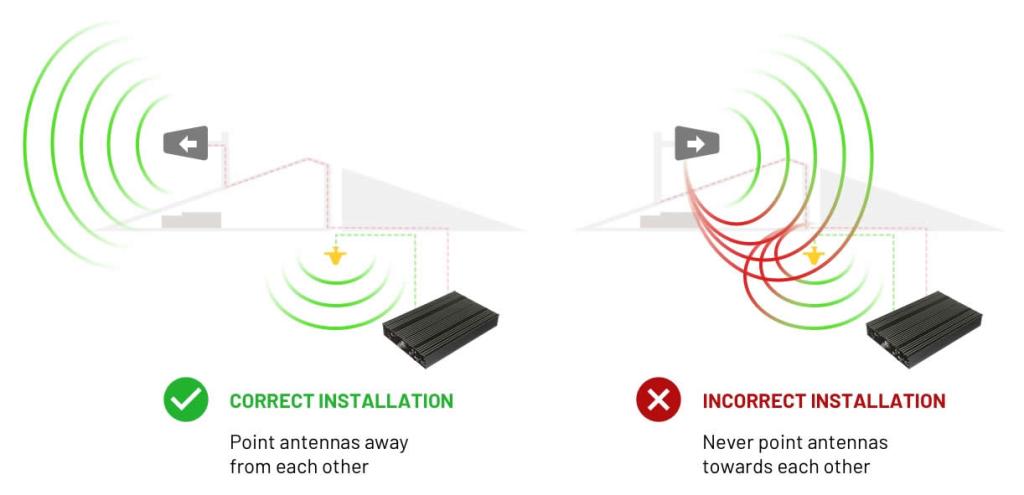
Measure the Signal Level Inside Before Turning On the Booster
Before you power on the booster, measure the signal level inside the building. Using the app, check the signal strength in dBm for more precision, refering to Measure Signal Frequency Bands. This will serve as a baseline comparison after adjusting the external antenna.
Examples:
Position and Rotate the External Antenna
- Install the external LPDA antenna at the designated location, such as the roof or another optimal spot.
- One person should adjust the antenna direction, while another stays inside, monitoring booster’s working status. Watch after each adjustment.
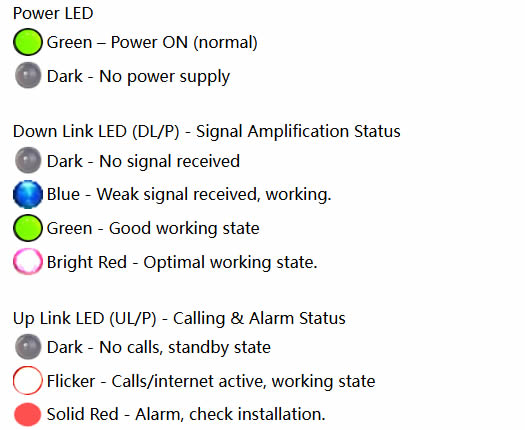
- Rotate the antenna 1/8th of a full circle (45 degrees) and repeat watching the booster’s working status. Continue rotating and watching in all 8 directions (360 degrees).
- After testing all directions, there is one directional making the booster in best or good (if no best) working state (see down link LED DL/P indications) while up link LED UL/P not in Alarm state. This direction providing the strongest signal should be selected.
- Securely fix the antenna in that direction and ensure it remains in place.
This process ensures that you find the optimal antenna position for maximum signal strength.
Too complicated? You may upgrade LPDA antenna to high gain pipe antenna, an omni-directional antenna for outdoor installation, pointing to sky vertically, donot care cell tower directions.
Additional Tips:
- Mounting the Antenna
We recommend mounting the external antenna on the side of the building, aiming away from the building. This will reduce potential obstacles and interference.

- Perform Testing in Pairs
For efficiency, we recommend working with a partner — one person can adjust the antenna while the other monitors the signal.
By following these steps, you’ll ensure the external antenna is positioned correctly to maximize your booster’s performance.